Buying a loft in Courchevel often starts with a wave of enticing photographs and ends with a very practical question: how do you compare properties that look spectacular but share almost no common criteria? Between the different altitudes of the resort, the varied interpretations of the word « loft » and the specifics of French co-ownership, each listing hides details that only emerge once you line them up side by side.
This guide gives you a structured way to shortlist and visit lofts in Courchevel using the same comparison grid for every property: surface, view, sector, furnished status and charges. The goal is simple — move from scattered listings to a shortlist built on criteria you can actually defend, without rushing a high-value decision.
Direct answer: To find the right loft in Courchevel, define your sector (1850, 1650, 1550, Le Praz) and ski access needs, then compare every property on the same grid of criteria — real surface, views, furnished status, co-ownership charges and acquisition costs — rather than relying on individual listings.
What to keep in mind before visiting Courchevel lofts
- « Loft » in Courchevel usually describes an open-plan apartment within a co-ownership, not a converted industrial space.
- Altitude and village (1850, Moriond 1650, Village 1550, Le Praz 1300) drive both views and price.
- Furnished status directly affects seasonal rental potential and legal framework.
- Beyond the price, plan for notary fees, co-ownership charges and resort-specific maintenance.
- Prices and availability change quickly and should always be confirmed with the agency.
What defines a loft in Courchevel and how it differs from an apartment or condo
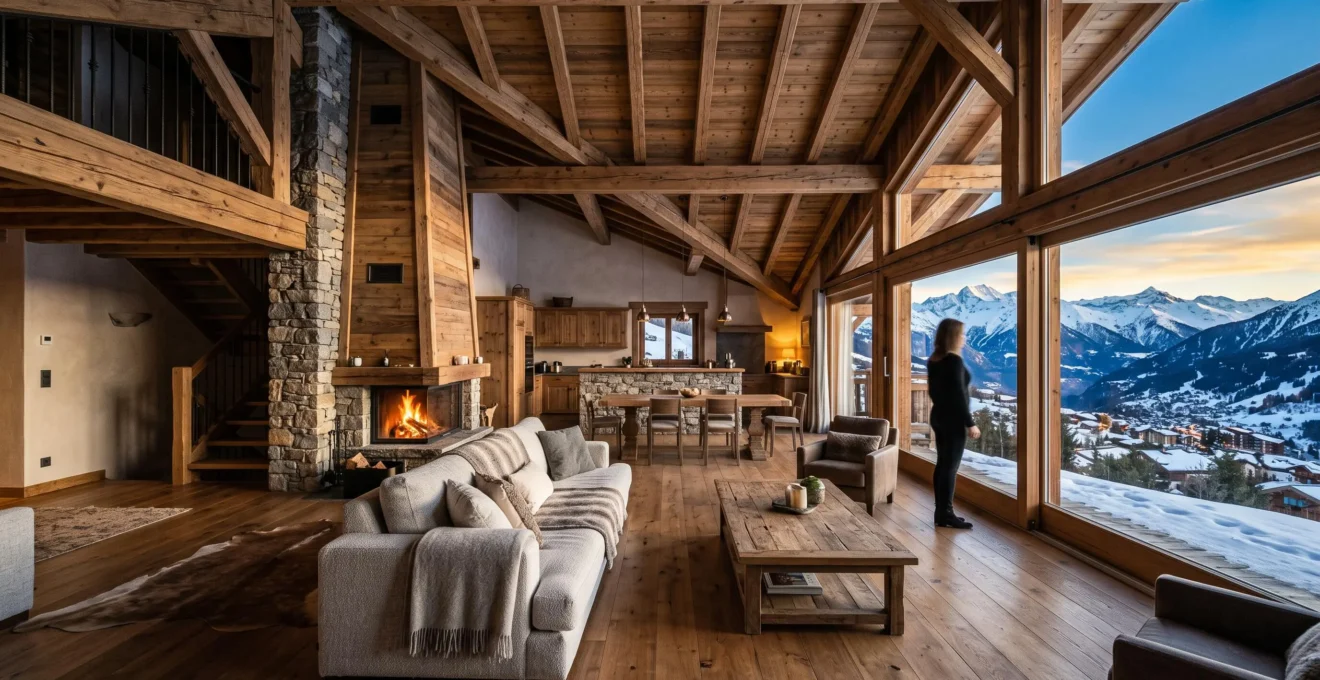
In Courchevel, the word « loft » is used more loosely than in cities like Paris or London. Rather than a former workshop or warehouse, it most often describes an open-plan apartment within a chalet-style co-ownership (copropriété), with generous ceiling height, few interior partitions and large windows framing the mountains. The underlying legal object remains a lot in a co-owned building, governed by French property law and the building’s règlement de copropriété.
For an English-speaking buyer, it helps to translate the vocabulary before translating the price. A « condo » in the North American sense roughly matches a lot de copropriété: you own your private unit and a share of the common parts. A « loft » is a stylistic sub-category of apartment, not a separate legal status. Among the courchevel 1850 apartments for sale, lofts tend to stand out through volume and layout rather than through any specific legal regime.
Typical features of a Courchevel loft
- Open living, dining and kitchen area under a high or sloped ceiling.
- Exposed timber beams, stone walls or raw concrete elements kept visible.
- Mezzanine levels used as sleeping or working areas.
- Large glazed façades oriented toward the slopes or the valley.
- Fewer load-bearing partitions, allowing flexible furniture arrangement.
Why furnished status and typology matter
Two lofts of similar surface can behave very differently depending on whether they are sold furnished (meublé) or empty, and depending on how the co-ownership rules classify short-term rental. A furnished unit may be immediately usable as a meublé de tourisme, while an unfurnished one requires investment before any rental activity. The règlement de copropriété may authorise, restrict or prohibit short-term rentals, which should be checked in writing before any offer.
Which locations in Courchevel offer the best views and access?
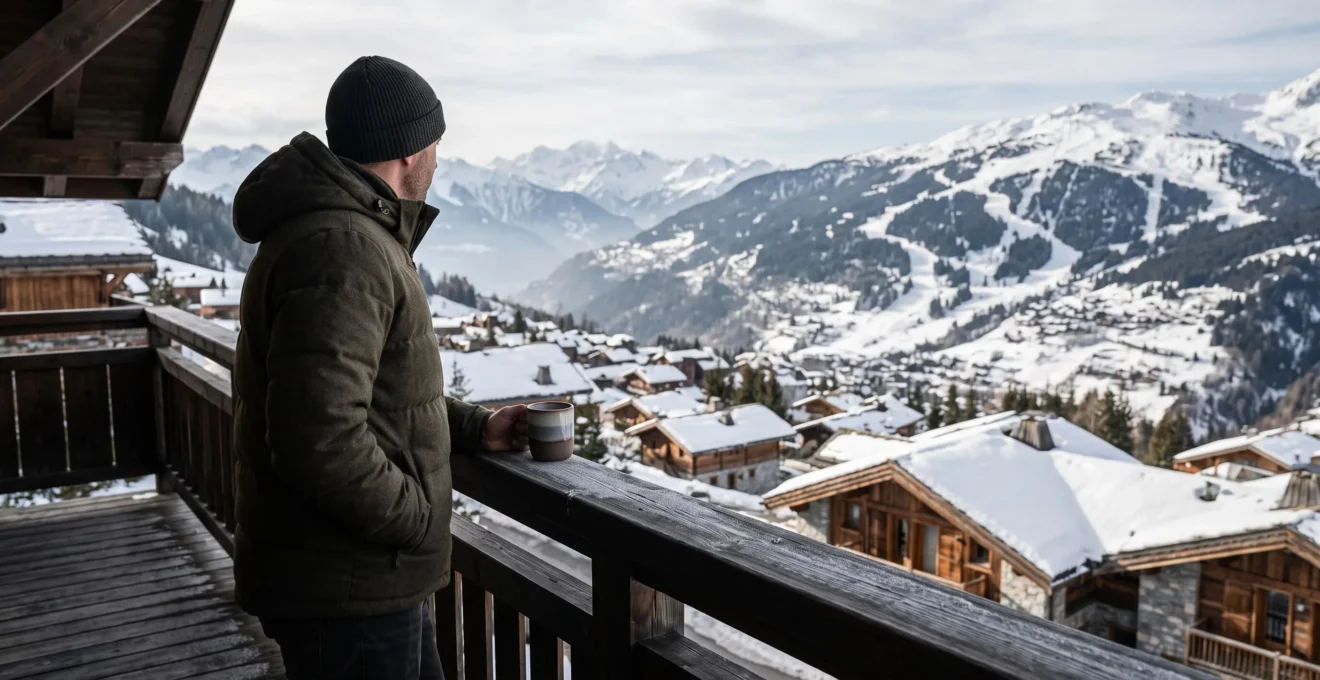
Courchevel is not a single village but a resort organised across several altitudes, each with its own character. According to the Les 3 Vallées resort page for Courchevel, the destination includes villages such as Courchevel-Le Praz at 1,300 m and Courchevel-Moriond at 1,650 m, with distinct atmospheres and settings. For a loft buyer, this altitude ladder translates directly into differences in view, sunlight, ski access and price positioning.
Comparing the main altitudes
Courchevel 1850 is the most internationally recognised village, with dense ski-in/ski-out options and the strongest premium on prices. Courchevel Moriond (1650) is often described as sunny with wide valley views, while Courchevel Village (1550) and Le Praz (1300) tend to offer a more traditional Savoyard atmosphere. Lower altitudes usually involve more use of lifts or shuttles to reach the main ski area, which should be weighed against potentially gentler price levels.
| Criterion | Courchevel 1850 | Moriond (1650) | Le Praz (1300) |
|---|---|---|---|
| Altitude | 1 850 m | 1 650 m | 1 300 m |
| Atmosphere | International, high-end | Family-friendly, sunny | Traditional village |
| Typical ski access | Dense ski-in/ski-out | Direct access to many slopes | Access via gondola to upper slopes |
| Price positioning | Highest in the resort | Intermediate | Generally more accessible |
Village characteristics evolve, and these indications should be confirmed with a local agency before any decision.
Ski-in/ski-out, exposure and real-world use
True ski-in/ski-out access can save considerable time each morning and tends to support both personal enjoyment and rental attractiveness. South-facing balconies capture more sunlight and extend outdoor use, while north-facing units may offer cooler, drier interiors and preserved snow views. A loft perfectly placed on the slopes in 1850 and an equivalent loft one village below can represent very different trade-offs between budget, prestige and daily convenience.
Key features to check before buying a loft in Courchevel
Once you have narrowed down a village and an altitude, the comparison between individual lofts should rest on a stable set of criteria. The goal is to turn each visit into a scored evaluation rather than an emotional reaction to décor or staging. A simple grid, used identically for every property, is the most effective way to keep options comparable.
- Real surface and layout
Verify the Carrez surface stated in the pre-contract, measure ceiling height under the sloped parts, and check how usable the mezzanine really is.
- Natural light and orientation
Note the orientation of main windows, the time of day when the living area receives direct sunlight, and any obstruction by neighbouring buildings or trees.
- Furnished status and rental potential
Confirm whether the loft is sold furnished, which items are included, and whether short-term rental is compatible with the co-ownership rules.
- Co-ownership charges and works
Request the last three years of charges, the minutes of general assemblies and any scheduled works affecting roof, façade or lifts.
- Mandatory diagnostics and documents
Review the full set of required diagnostics (energy performance, lead, asbestos where relevant) and the règlement de copropriété.
Cas pratique
Consider a hypothetical shortlist of two lofts of similar advertised surface in Courchevel. Loft A, in 1850, is furnished, ski-in/ski-out and shows annual co-ownership charges markedly higher than Loft B, located in Moriond, unfurnished, with a short walk to the lifts. On paper, Loft A looks more « turnkey », but once charges, acquisition costs and refurbishing budget for Loft B are projected over several years, the total cost gap narrows. The right choice depends on how much the buyer actually values immediate ski access and furnished delivery versus flexibility and lower running costs. This hypothetical scenario is illustrative only.
What budget and hidden costs should you plan for?
Advertised prices in Courchevel vary widely between villages, buildings and finishing levels, and they tend to evolve with market conditions. For this reason, any budget planning should start from a precise reference point: the actual listings offered by your chosen agency at a specific date, flagged as subject to change. A loft purchase is not only the sticker price — several categories of costs come on top and should be anticipated from the start.

Acquisition and recurring costs
French property acquisitions typically include notary fees (frais de notaire), which combine registration taxes and the notary’s own fee, as well as any agency commission depending on the mandate. On top of the purchase, resort properties carry year-round co-ownership charges, heating, snow management and sometimes concierge services. These running costs can be significant in high-standard chalet buildings and should be read carefully before signing.
Prices and running costs to confirm: figures mentioned by agencies, portals or past articles may be outdated. Always ask for an up-to-date charges statement and a written estimate of acquisition costs before committing.
Seasonal rental: a regulated activity
If part of your plan is to rent the loft when you are not using it, French law treats this activity as a regulated short-term rental. The Direction générale des Entreprises page on meublés de tourisme defines these rentals and recalls that each stay is capped at 90 consecutive days per guest, under article L.324-1-1 of the French tourism code. In parallel, the Notaires de France overview of furnished tourist rentals explains that since 21 November 2024, any new co-ownership rules must state whether such rentals are authorised, and that national registration will become compulsory by 20 May 2026 at the latest.
In practice, this means two checks before relying on rental income: confirm what the règlement de copropriété allows, and confirm the local commune’s rules, which may further restrict duration or require registration. These regulatory elements evolve regularly; information above should be verified against the current legal framework and, where needed, with a notary.
Important distinction: this article provides general information on property purchases and short-term rentals in France. It does not constitute personalised legal, tax or investment advice. For any binding decision, consult a notary and, where relevant, a tax adviser.
How to shortlist and visit lofts efficiently
Travelling to Courchevel to visit several lofts in a short window of time is a logistical exercise. A good shortlist, prepared before the trip, is the main lever to make those days productive. The same comparison grid used during visits should guide the pre-selection, so that only lofts matching your core criteria make it to the itinerary.
Building a usable shortlist
Start from your non-negotiables: village, maximum budget, ski access, minimum surface and whether you need the property to be already furnished. Apply those filters on the agency’s listings and on your preferred property search tools, then remove any loft where the règlement de copropriété or the charges are not available. It is better to visit four lofts with full information than ten with incomplete files.
- Primary use is personal, ski-focused:
Prioritise ski-in/ski-out lofts in 1850 or Moriond, even if surface is more modest.
- Mix of personal use and seasonal rental:
Favour furnished lofts in buildings where short-term rental is clearly authorised.
- Priority on budget and traditional atmosphere:
Explore Le Praz and Courchevel Village, accepting more reliance on lifts for ski access.
Organising visits over a short stay
Group visits by village to minimise travel time between appointments, and keep at least one slot for a second viewing of the two or three lofts that stand out. Ask systematically about charges, planned works, occupancy of the building during peak weeks and any rental history. These questions often reveal information that was absent from the listing and that can tip a decision one way or another.
If you are also considering more urban alternatives for part of the year, it can be useful to compare the dynamics of mountain lofts with those of city apartments; a broader perspective on the appeal of urban condos for buyers can help clarify what you really value in a secondary residence.
Is Courchevel 1850 worth the premium over lower altitudes?
Courchevel 1850 concentrates the most international profile, the densest ski-in/ski-out offer and the highest prices. The premium can be justified when direct slope access, prestige and resale liquidity are priorities. For buyers more focused on atmosphere, sun exposure or budget, Moriond, the Village or Le Praz can offer compelling alternatives, usually at lower price levels.
Does furnished status really matter for seasonal rental income?
Yes. Short-term rental in France generally relies on the meublé de tourisme framework, which requires the loft to be properly furnished and equipped. Beyond the legal aspect, the quality and completeness of the furnishings strongly influence occupancy and nightly rates. An unfurnished loft can still be rented out, but only after an equipping phase that should be budgeted upfront.
What extra costs apply when buying a loft in a French ski resort?
In addition to the purchase price, buyers in France usually face notary fees (including registration taxes), possibly agency fees, and recurring co-ownership charges. In a ski resort, those charges often include heating, snow clearing and sometimes concierge or wellness services. Property tax and, where applicable, specific rental-related taxes also apply. Exact amounts should be confirmed with the notary and the managing agent.
Can I rent out my loft freely when I am not using it?
Not always. Short-term rental is subject to the règlement de copropriété, local commune rules and national regulations on meublés de tourisme. Since late 2024, new co-ownership rules must state whether such rentals are permitted, and a national registration regime becomes compulsory by 20 May 2026. The ability to rent, and under what conditions, should be checked in writing before purchase.
Finding the right loft in Courchevel is less about chasing listings than about applying a stable method: define your sector and non-negotiables, use the same grid for every visit, and treat each price or figure as a data point to be confirmed with the agency and, where relevant, with a notary. With that discipline, a market that initially feels dominated by scarcity and premium pricing becomes a more readable decision, aligned with how you actually plan to live in — and possibly rent — your Alpine pied-à-terre.